


We're committed to ending domestic abuse
Here's the proof of our commitment. As accredited Gold Standard DAHA members, the way we train our staff and deal with domestic abuse is specifically aimed to help you in your individual circumstances.
Are you experiencing a pattern of threatening, degrading or violent behaviour in your home? You don't need to suffer alone.
Are you worried about your own relationship? Is your partner controlling, manipulative, abusive or violent? Does something feel not quite right?
Are you worried about your own behaviour? Are your family frightened of you? Do your friends or other family members tell you that you're being unreasonable?
If you said 'yes' to any of these questions - or you know any of our customers who this applies to - please get in touch.
We can offer you advice and support options for staying safe. We will also signpost to specialist services that can help.
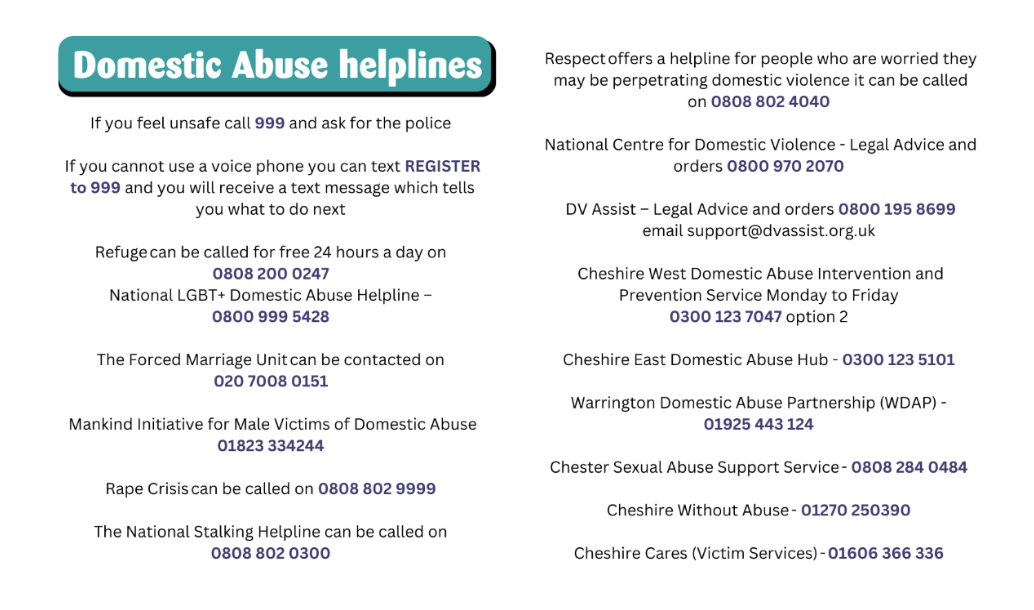
The hub is available 24/7, whether you're concerned for yourself or somebody else.
Don't live in Cheshire East?
Derbyshire Domestic Abuse 24 Hour Helpline
Bright Sky is a free to download mobile app providing support and information for anyone who may be in an abusive relationship or those concerned about someone they know.
Worried that you might be abusing someone? You can get help and support.
Respect Phoneline is free and offers confidential and judgement-free advice to help you stop abusing people.
Domestic Abuse can also manifest as non-physical by way of:
Controlling behaviour is a range of acts designed to make a person subordinate and/or dependent. This may include isolating them from sources of support, depriving them of independence, and regulating their everyday behaviour.
Coercive behaviour is an act or a pattern of acts of assault, threats, humiliation or intimidation, or other abuse that is used to harm, punish, or frighten someone.
Reporting a domestic abuse - what happens next
When we receive a report, we will:
You can seek support from our Safeguarding and Domestic Abuse Officer, any member of the Customer Support and Enforcement Team or Neighbourhood Officer. We also have trained Domestic Abuse Champions across the Trust who you can speak to.
We will take all reports seriously and respect the confidentiality. Where appropriate, we may work with you to create a safety action plan and a DASH Risk Assessment (Domestic Abuse Stalking and Harassment Risk) to help understand risks and agree the next steps together.
Rehousing advice and options
In some situations, and where it is safe and appropriate to do so, we may be able to offer additional safety measures. This involves practical changes to a property to help improve security and reduce risk, for example enhanced locks, door or window security or other safety measures. Any decision to consider target hardening would be based on a discussion with you, your individual circumstances, and an assessment of risk, alongside advice from specialist partners where needed.
Social housing is in high demand, and waiting times to be rehoused can be substantial. Wherever possible, Peaks & Plains and the local authorities we work with aim to support individuals and families to remain safely in their current home.
However, we recognise that in some cases the risk may be too great. If remaining in your home presents an immediate risk of harm, you may need to consider temporary accommodation through the local authority or refuge accommodation via specialist domestic abuse services.
If you do not feel safe to remain in the local area, you can approach any local authority homelessness service and request a homeless assessment due to fleeing domestic abuse.
Clare's Law - domestic violence disclosure scheme
Clare's Law allows you to request information about your partner, ex-partner, if you are worried they may have a history of abuse and pose a risk to you. You can also request information about a friend or relatives partner if you are concerned about their safety.
Sarah’s Law - child sex offender disclosure scheme (CSODS)
Sarah’s Law enables parents, carers and guardians to ask the police whether someone who has contact with a child has a history of sexual offending or poses a safeguarding risk.
You can make a request if:
Sarah's Law (Child Sex Offender Disclosure Scheme) | Cheshire Constabulary
Here's the proof of our commitment. As accredited Gold Standard DAHA members, the way we train our staff and deal with domestic abuse is specifically aimed to help you in your individual circumstances.